- Develop democratic fashioned in Africa –Obasanjo
- Says judiciary needles in democracy
- Jonathan calls for power-sharing model, says Nigeria needs governance reform
- Peter Obi: judiciary, legislature, professors aiding electoral fraud
- Douye Diri demands true federalism, fair resources distribution
- Political parties are being armtwisted by institutions of government –IPAC
By Rauf Oyewole
Political leaders in Nigeria and Africa have called for restructuring of democracy inherited from the colonial masters, saying that the current system being practiced across the continent was not design to suit the African society, however calling for a system of government that reflects African values, cultures and traditions.
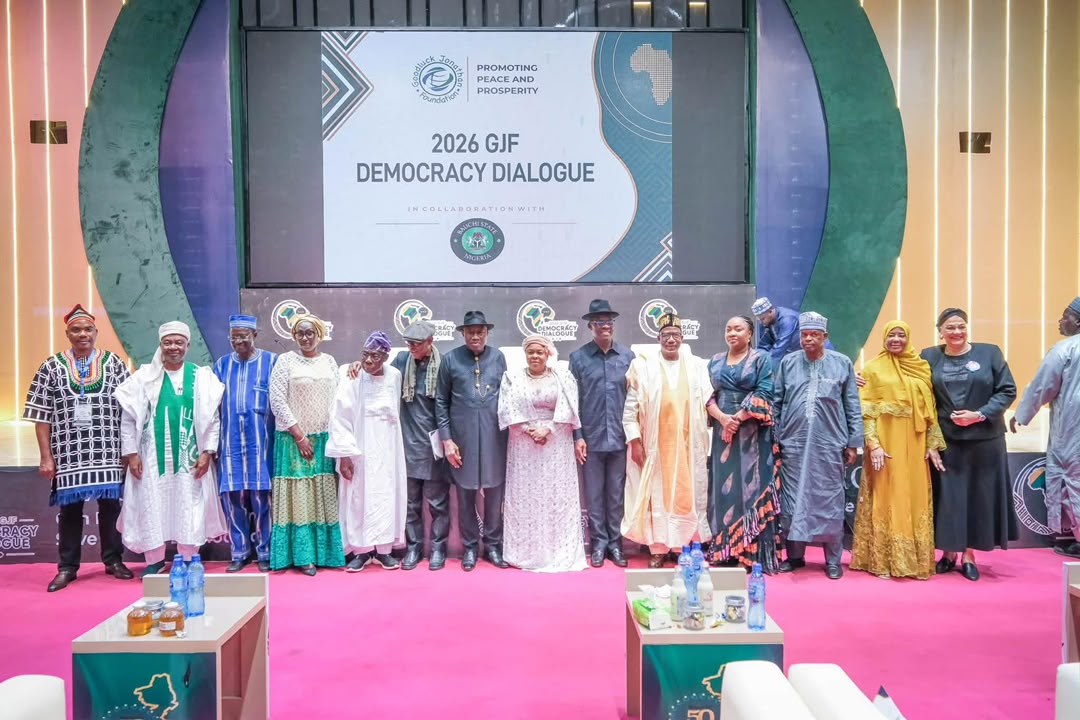
The leader who spoke at the 2026 Democracy Dialogue organised by Goodluck Jonathan Foundation, held in Bauchi on Tuesday, themed: “Beyond Elections: Can Political Parties and the Judiciary Save African Democracy”.
While delivering a speech, former president Olusegun Obasanjo, who was the Chairman of the Conference, argued that, “Is there African democracy? Let us not deceive ourselves. There’s nothing like African democracy. We were given Western liberal democracy by our colonial master.”
Obasanjo said that he has been increasingly worried about the performance of democracy in Africa, and in other regions of the world. “Let me emphasise that we are referring to Western liberal democracy, because the Chinese will not agree with you that their own democracy is dying. And maybe the Swiss, who have practiced some form of direct democracy, may also not agree with you that their democracy is dying.”
He argued further that liberal Western democracy, which is practiced in Europe, the Americas, of which substantial parts of Southeast Asia and Australia, and Africa… “our European colonial masters had nothing else to give us, what they have, we swallowed it, hook, stock, and barrel. Has it delivered, or is it delivering, or will it deliver? These are the questions that we must ask ourselves. And these are the questions that are very important.
“It doesn’t matter whether political parties remain as they remain, but I hope they will not remain as they remain. Or the judiciary is captured, controlled, or independent. Of what need is the judiciary in government? What purpose does it serve that when millions of people have voted, then five people will come to decide either in favor or against the decision of millions of people? Is that democracy? It cannot be a democracy,” he said.
He stated further that good governance should take care of the welfare and well-being of the people, should guarantee equity, sense and feeling of belonging, and take them forward at the nations’ life and activity, protection of life and property, no marginalisation, no discrimination, no exclusion.
“Democracy that works is meant to deliver dividends of democracy in terms of quality of life and living for all the people in a geographical entity, all the nation.
“If you try to use (democracy) what is not meant for you to serve your purpose, it’s like a dress for which you are not measured. You are trying to put it on. It’s either too small for you or too big for you. It will not fit, and it will not serve your purpose. In practice, what we have, we have one party form. If you win by one vote, then you take it all. And whatever you have does not matter. See poor management of diversities. You cannot have a democracy that completely rides roughshod over diversity, because you have civil society and mass society.”
The former President lamented about what he called “abusive democracy” which he said does not help democracy.
He said that Nigeria has gender bias, saying that since the beginning of the fourth republic the country has not elected a female governor in 27 years.
“And yet, there are people we elect, most of them lack character, lack attributes and values, and cannot lead. We’re watching the way forward. I believe we need more political parties.”
Suggesting a way forward, Obasanjo advocated for an African fashioned system of government that is rooted in the cultures, values and traditions of Africa.
The former President who insisted that democracy was imposed on Africa urged leaders to design a system that will be clearly authentic Africa. “Call it what you like, just make sure it contains peace, culture, and values that are African. You can call it African democracy if you like. You can call it African democracy. In that case, it will be African with African context and African content. Political parties may be part of it, as we may think as we go along, but in a different way, and the military may have little or nothing to do with democracy and establishment of government.
“We have to do innovative, positive, disruptive thinking and take action out of the box. Maybe we should begin with the re-examination of people representatives or community representatives, rather than the hijacked representatives by political parties,” he said.
Obi: Professors aiding illiterates to rig election
The Presidential candidate of Nigeria Democratic Congress (NDC), Peter Obi who lamented the eroding trust in judiciary, legislature and academia, fraud is being aided by the elites.
“Look at what is happening today in Nigeria, where professors are now aiding illiterates to rig election, where our lawmakers have removed forgery as an offense in electoral matter, a senior advocate of Nigeria defending forgery. Our religious leaders are now praying for criminal politicians for blessing.
“We have a crisis, and above all, our judges are now singing on your mandate will stand. So it is a big problem on all of us, unexamined life is not worth living. It is time for every Nigerian to sit down and ask ourselves, where is our nation going? We need to reverse this, because the abuse we are allowing today will take its revenge on our children.”
Jonathan: Nigeria needs power-sharing model, governance reform
The Chairman of the Foundation and former President Goodluck Jonathan has called for a review of Nigeria’s presidential system, advocating a governance structure that distributes executive powers among key institutions and reduces the concentration of authority in one individual.
Jonathan, making his remarks on democratic governance, judicial independence and electoral reforms, argued that Nigeria should consider returning to a parliamentary system similar to the one operated during the country’s pre-independence and early independence years.
He called for a fundamental review of Nigeria’s governance structure, advocating a system that would distribute political powers rather than concentrate them in the hands of one individual.
Jonathan said Nigeria could explore a model similar to Switzerland’s system, where major national decisions require broad agreement among members of the governing team. He argued that concentrating excessive powers in one person could have serious consequences for the country, stressing the need for institutional checks and shared responsibility in decision-making.
He explained that under such an arrangement, executive responsibilities would be divided between the Prime Minister, who controls government resources and administration, and a President or other head of state responsible for commanding the armed forces.
Jonathan said such a structure would create mutual checks between the holders of political and military authority, unlike the current presidential system where, in his view, too much power is concentrated in one office. He therefore urged Nigerians to engage in broader conversations on the structure of governance and determine the model that best suits the country’s unique circumstances.
On the judiciary, the former president stressed the importance of fairness, independence and impartiality, describing the judiciary as the final guardian of constitutional order.
He expressed concern over the increasing tendency for electoral disputes in Nigeria to be settled in courtrooms rather than at the ballot box, noting that the situation was significantly different from many other African countries.
According to him, Nigeria’s political system had become so accustomed to election litigation that parties often make provisions for legal battles when preparing their election budgets.
Jonathan, however, acknowledged that not every electoral dispute should be taken back to the voters, stressing that criminal offences committed during elections must appropriately be handled by the courts.
He questioned the increasing role of courts in determining political party candidates and, in some instances, deciding which political party should be recognised.
Jonathan warned that such interventions could further destabilise Nigeria’s political environment.
He said democracy was an ecosystem involving political parties, electoral management bodies, security agencies, the judiciary, civil society organisations, the media, international observers and voters.
Diri: There is injustice in resources distribution
The Governor of Bayelsa State, Douye Diri argued that democracy is about the rule of law, and it is built on three pillars. “The pillars of justice, equity, and fairness. And I believe that we have missed the road of democracy in Nigeria long ago. Because there is no justice where oil in Oloibiri that gave this country an oil commercial producing country.
“Oloibiri today is a shadow of itself. And all of us come to Abuja at the end of the month to come and share oil money. I don’t think that that’s what democracy is all about. I don’t believe that the local government that brings so much money to Nigeria, Southern Ijaw Local Government…For 60 years, they have no access to the headquarters of that local government. It is only recently that I have concluded a 630 meters long bridge to the headquarters of that local government.
“And so to my mind, there is total injustice where I have just eight local government areas. Some other states have 40 local government areas and above. And the resources from my state is used to share to those local government areas. And I have only eight.
“There is injustice. And wherever that become president, the injustice continues. The unfairness continues. Resources are expropriated. Today there is gold in Zamfara and other places. And what do we experience? Insecurity. Most of the insecurity is also traced to the discovery of gold in that far north.
“For for it (democracy) to thrive in Nigeria, there must be true federalism. And until Nigeria begins to practice federalism, we will have some pseudo-democratic, pseudo-autocratic, and sometimes even a tyrannical government in this country,” he said.
IPAC: Political parties are being arm-twisted
The Chairman, Inter-Party Advisory Council (IPAC), Yusuf Mamman Dantalle believed that there is destruction of political parties.
According to him, political parties, over the years, as institutions were stronger. Saying that leadership of political parties did not belong to elected officials. “Each party was a structure on its own independently. And when people are elected or parties decide, political parties ensure that elected officials align with the manifestos of the party.
“Until we got to a point that the National Assembly, in tandem with some executive officers who feel it is better for them to have control of political parties, chose to weaken political parties by taking over the leadership from political party structure to the executive arm of the government. And in doing that, also, the subvention given to political parties was withdrawn, and parties were left at the mercy of who is able to pay or drive the political party financial activities to determine what happens in the party.
“If we must get it right, I think it is something that both the previous leaders, the current leaders, the legislators, and all Nigerians should be sincere to see that we restore the strength of the institution of political parties. Because today, it is about who have the financial wherewithal and who is in power, who can pay, and also use the institution of the judiciary to destroy internal democracy in political parties.
“Most of the factions in the political parties today, I’m sorry to tell you, they are manufactured.”
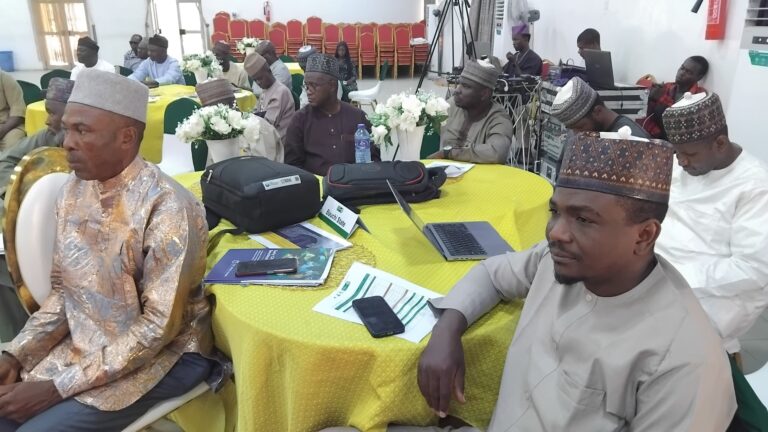
The Conference was attended by the former President of the Senate, Sen. Anyim Pius Ayim, Bayelsa Governor; Douye Diri, Professor Karuti Kanyinga from University of Nairobi, former Prime Minister of Burkina Faso and former President of the ECOWAS Commission; Kadre Desire Ouadraogo, Hon. Johnson Aseidu Nketia; Chairman, National Democratic Congress, Ghana, member of the National Assembly, Republic of The Gambia; Hon. Fatoumatta Njai, former INEC Resident Electoral Commissioner; Barrister Mike Igini, Prof. Hassan Salihu of University of Ilorin and other stakeholders across Nigeria.