By Silas John
Minister of State for Petroleum Resources (Oil), Heineken Lokpobiri, said on Wednesday that Nigeria’s crude oil production has climbed to over 1.8 million barrels per day, crediting “collective effort” under President Bola Tinubu’s administration for reversing years of decline.
Speaking at the opening of the 2026 Nigerian Oil and Gas Energy Week in Abuja, Lokpobiri recalled that when he met President Tinubu in August 2023, Nigeria was producing “one million barrels a day,” a level the President described as “unacceptable.”
“I made a commitment to him: We will remove all the bottlenecks,” Lokpobiri told stakeholders from government, industry, and academia. “Today, the last weekly report I got from NUPRC shows we are doing over 1.8 million barrels a day, inclusive of condensate.”
But he insisted 1.8 million bpd “is not enough.” “We’ve done 2.5 million barrels before. We can do it again,” he said, adding that pressure to raise output has grown amid renewed global demand. “I receive delegations from the U.S., Europe, the Middle East. They want to buy Nigerian oil. Fortunately, we don’t have enough to sell. But in the next few years, we will.”
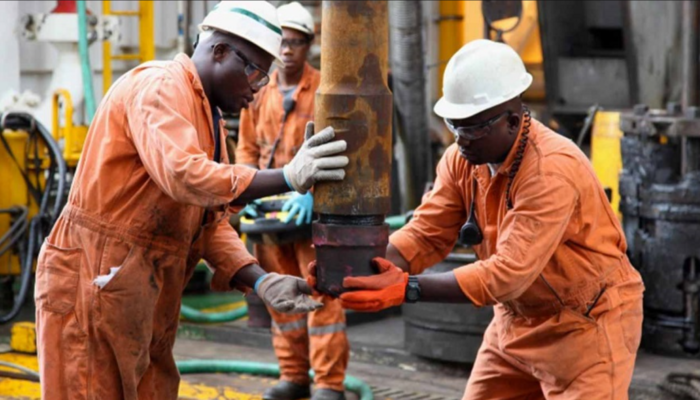
Lokpobiri linked the production rebound to a sharp rise in drilling activity. When the administration took office in 2023, Nigeria had about 14 active rigs, according to NUPRC records. “Today, we have over 60 active rigs. That is what will guarantee the future growth in the industry. This is where the new barrels will come from.”
He argued that sustained investment is non-negotiable for growth. “Oil and gas will not happen without deliberate investments. You want to increase your production, you can only do that with sustained investment in the sector.”
The minister said a decade-long investment drought had pushed capital to places like Guyana and Angola. “So we went to the drawing board,” he said. The result was a series of reforms aimed at making Nigeria competitive again.
Key among them were the divestments approved by President Tinubu after consultations. “As minister, I was chief adviser to the president. I was very consistent, and at the end of the day, the president took the bold decision.”
Renaissance has since acquired Shell’s assets, Seplat took over ExxonMobil’s, and Oando acquired Eni/NAOC assets. “Today, it is very good news that the independents account for over 60% of our daily production of 1.8 million barrels per day,” Lokpobiri said. “When those decisions were about to be taken, some people thought we were foolish… But these are the same people who ran these assets under Shell. Why can’t we challenge them?”
He stressed that no IOC left Nigeria. “Rather, they have gone deep offshore… to increase our reserves, increase our production, which will translate to more employment, more dollars.”
Lokpobiri also pointed to full deregulation of the midstream and downstream sectors as critical to capturing more value. He praised Dangote Refinery, BUA, and NNPC’s efforts to rehabilitate the Warri and Port Harcourt refineries. “That is the right way to go… You have my fullness of support,” he told NNPC’s Group CEO.
Responding to industry complaints about Nigeria’s “270 fees, taxes, rents,” Lokpobiri said the government has commissioned PwC to benchmark Nigeria’s fiscal terms against other jurisdictions. “Sometimes… it will take you the same paperwork to pay one million dollars as you want to pay one cent,” he said. The goal is to consolidate payments and ensure Nigeria is “globally competitive.”
He added that the Petroleum Industry Act’s “drill or drop” provision is being enforced to sustain exploration. “It is only when we sustain this drilling campaign that we can continue to grow our reserves.”
To underscore the point, Lokpobiri congratulated Renaissance Nigeria for a deep offshore discovery in OML-74. “Renaissance Nigeria embarked on a drilling campaign deep offshore and found amazing reserves,” he said, calling on other companies to follow suit. He noted Nigeria’s 37 billion barrels of reserves are “restricted to the Niger Delta” and based on “records maybe 30 years old.” “A lot more lies in the Niger Delta and other basins we haven’t even explored.”
He also argued that the global conversation has moved from “energy transition” to “energy mix.” Citing the International Energy Agency’s 2025 report, he said the world needs $1 trillion in annual investment for the next 25 years to avoid an energy crisis, with $750 billion in oil and gas.
“When the global crisis happened in January, those who were saying we should abandon crude oil were those who released their reserves,” he said. “You guys have used fossil fuels to industrialise. You want us to industrialise without energy? … Africa is only responsible for 3% of emissions. Why do you want the man with 3% to abandon his 3%?”
Lokpobiri opened his remarks by thanking DMG Events and sponsors including NNPC for sustaining the Nigerian Oil and Gas Energy Week for 25 years. “Coming up with this ingenious idea is the reason why we are all gathered here today,” he said, drawing applause.
He closed by formally declaring the 2026 Energy Week open, urging stakeholders to “enjoy” the deliberations. “We are not where we want to be. But we are not certainly where we were three years ago,” he said.