Gabriela Ezin
Governors of the South-South states have resolved to pursue regional rail development, modernisation of seaports and coordinated investment to strengthen economic integration and unlock the region’s development potential.
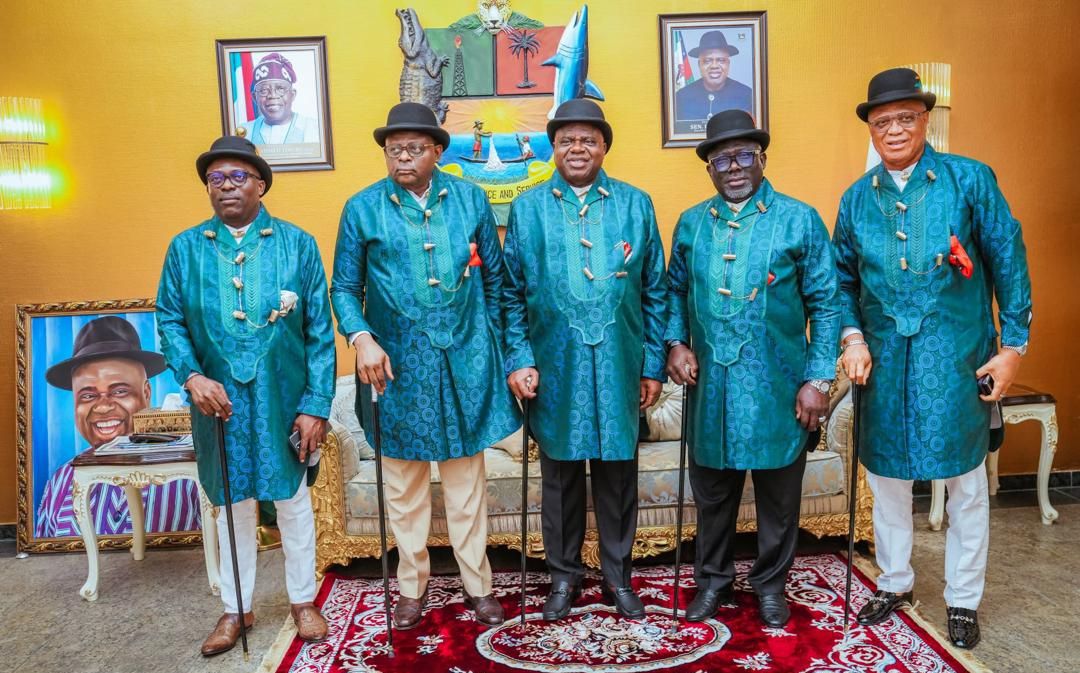
The governors, who met in Calabar, Cross River State, in September 7, also resolved to engage President Bola Tinubu on infrastructure, environmental remediation and other regional concerns, while pledging 100 per cent support for his re-election in 2027.
The resolutions were contained in a communiqué issued at the end of the second meeting of the South-South Governors’ Forum, chaired by Bayelsa State Governor, Senator Douye Diri.
The forum identified the development of regional rail networks, rehabilitation and modernisation of the Calabar, Port Harcourt and Warri seaports, and opportunities presented by the Lagos-Calabar Coastal Highway as priorities for economic integration.
The governors also agreed to strengthen cooperation among the six states in security, environmental restoration, transportation and industrial development, stressing that regional challenges required coordinated responses rather than isolated state-level initiatives.
Speaking at the meeting, Cross River State Governor and Vice Chairman of the Forum, Senator Bassey Otu, said the region could achieve greater economic prosperity if its states worked together and presented a common position on issues affecting their development.
“We must come together as a people; we must cooperate, and we must ensure that our voice is heard and respected,” Otu said.
He maintained that the South-South had the resources and economic potential to become one of Nigeria’s strongest economic blocs but needed to overcome fragmentation and develop a common strategy for harnessing its natural and human resources.
Otu called for a unified regional position on fiscal equity, particularly Value Added Tax, oil and gas revenues, and the 13 per cent derivation principle.
He also sought the support of his colleagues for Cross River’s campaign to regain its oil-producing status, describing the issue as important to the state’s quest for greater economic opportunities.
On infrastructure, the governor proposed a regional economic corridor linking the proposed Bakassi Deep Seaport in Calabar with the East-West Road and ports in Bayelsa and Delta states.
He further advocated stronger integration of the region’s agricultural economies, urging the states to move beyond the extraction and export of raw materials to industrial processing, value addition and job creation.
Otu identified cassava production, processing and ethanol development as areas with potential to stimulate investment, create employment and strengthen the region’s industrial base.
In his opening remarks, Diri warned that the governors must move beyond meetings and resolutions to deliver concrete results for their people.
“We cannot afford to remain a region of meetings and communiqués,” he said, insisting that the gathering must produce “measurable progress”.
The Bayelsa governor said the South-South could no longer afford fragmented approaches to infrastructure, transportation, security, environmental remediation and economic development, given the interconnected nature of the challenges confronting the region.
He called for accelerated development of road, rail, air and maritime infrastructure, including the East-West Road, the Lagos-Calabar Coastal Highway and regional rail networks.
Diri also urged the region to position itself as Nigeria’s gas-industrial hub, West Africa’s maritime gateway and a leading centre for the blue economy.
On environmental concerns, he said the region’s contribution to Nigeria’s economic development had not been matched by adequate protection and restoration of its communities and ecosystems.
He called for expanded environmental remediation across the Niger Delta, arguing that economic activities should not leave host communities grappling with ecological degradation.
The governors also stressed the need for stronger intelligence-sharing and coordinated security operations to protect communities, oil and gas facilities, waterways and critical economic corridors across the six states.
In a related development, the National Chairman of the Pan Niger Delta Forum (PANDEF), Ambassador Godknows Boladei Igali, advocated the establishment of a regional investment fund to mobilise resources for major projects cutting across state boundaries.
Igali also urged the governors to prioritise young people in their economic transformation agenda.
The Director-General of the BRACED Commission, Ambassador Joe Keshi, presented proposals on regional infrastructure development, particularly rail connectivity, as part of efforts to strengthen economic cooperation among the states.
The forum resolved to institutionalise its meetings on a quarterly basis, with Uyo, Akwa Ibom State, scheduled to host the next meeting from November 6 to 8, 2026.
It also reaffirmed its commitment to supporting Tinubu’s re-election in 2027, while pledging to engage the President on the region’s infrastructure, environmental and economic priorities.