By Rufai Shehu
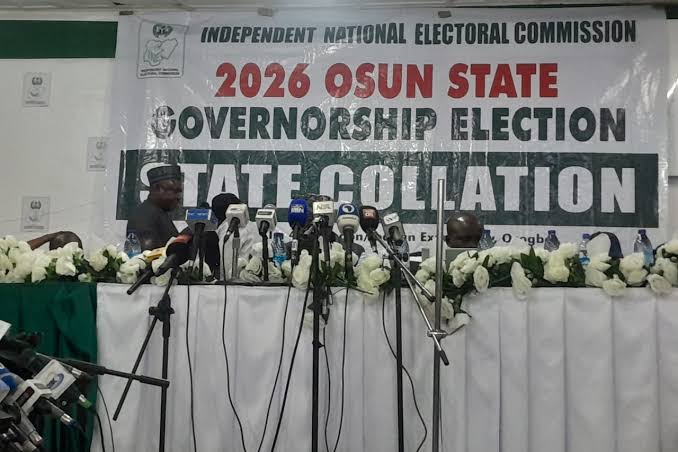
Osun held its breath through Saturday night. In Osogbo, Ilesa, Ede and across the 30 LGAs, phones did not sleep. WhatsApp broadcasts announced winners at midnight. Radio callers swore they had the real figures. By Sunday morning, the tension broke only when INEC’s state returning officer, Joshua Ogunwole, declared Ademola Adeleke of Accord the winner with 511,067 votes, ahead of APC’s Oyebamiji with 444,815. In that charged atmosphere, Nigerian journalists did what the law expects of them. They anchored a state in verifiable truth instead of echoing the loudest voice.
Their mandate to do so is not accidental. It is constitutional. Section 22 of the 1999 Constitution of the Federal Republic of Nigeria states: “The press, radio, television and other agencies of the mass media shall at all times be free to uphold the fundamental objectives contained in this Chapter and uphold the responsibility and accountability of the Government to the people.” That provision turns journalism from a job into a statutory duty. And Section 39(1) guarantees: “Every person shall be entitled to freedom of expression, including freedom to hold opinions and to receive and impart ideas and information without interference.” In Osun, reporters invoked both sections by choosing verification over virality.
The first test was speed versus accuracy. Many online platforms could not resist posting “projected winners” at 2am. By dawn some were deleting and apologizing. The outlets that endured were those that kept repeating one line: awaiting official INEC figures. That patience paid off. The final tally showed 985,079 valid votes out of 1,005,800 cast, with 20,721 rejected, and accreditation at 1,010,684 out of 2,339,544 registered voters. Those are numbers too important to guess. Journalists who waited did not just protect their bylines. They protected Osun from needless crises, fulfilling their Section 22 obligation to hold power accountable with facts.
Neutrality was the second test, and it was harder. This was not a faceless contest. It involved a sitting governor seeking a second term on a new platform, a major opposition push by APC, and ADC in the mix with 17,180 votes. Yet the most credible reports gave space to all sides. They showed party agents at collation, reported celebrations and concessions in the same bulletin, and avoided adjectives that anoint. That restraint reminded readers that the press is not a campaign department. It is a public ledger, and that balance is the clearest evidence of professionalism on display.
Nothing replaced being there. Reporters who stayed overnight at the INEC office in Osogbo captured what no tweet could: the sigh in the hall when the 66,252 vote margin was read, the body language of agents, the process itself. Community radio stations did live links from local government collation centers. That physical presence dismantled rumors faster than any press release. When people hear a familiar voice from their LGA say “we are still collating,” they wait instead of fight. This is journalism exercising its freedom under Section 39 to receive and impart information responsibly.
Data finally grew up in Nigerian election coverage. Within hours of the declaration, newsrooms turned raw figures into clean graphics. Bar charts showing Accord 511,067, APC 444,815, ADC 17,180 made the scale of the win obvious without commentary. Live blogs tracked results LGA by LGA. Infographics explained turnout and the difference between accredited and total votes cast. Social media was both the arsonist and the fire brigade, with 2022 photos recycled as “Osun 2026 violence.” Journalists fought back on those same platforms with explainers and fact-checks. They used their constitutional freedom not to inflame, but to educate.
OsunDecides2026 will be remembered not just for who won, but for how the story was told. With over one million votes cast and a tight race, the press had every incentive to sensationalize. Instead, guided by Sections 22 and 39, many journalists chose verification, balance, and context. That choice is why the result landed without burning the state down. Journalism at its best does not just record democracy. It defends it. And in Osun this weekend, it did.